Special Assignment: Instagram Before and After Abroad

Taking a look back at my Instagram account over the last few months of me living in Barcelona studying abroad, I can see a huge shift between what I decided to post now versus what I used to post prior to this experience. It is interesting to think about because before this assignment was handed out, I never really thought about the changes that have occurred within myself and how I view myself online, in relation to how life fully is while here in Barcelona. Whether I like it or not, there has been a huge change in my online Instagram behavior when it comes to my decisions on what to post, my sense of urgency to get a good picture, as well as posting Instagram story highlights that reflect the “perfect” trips and life I have here while studying abroad. Beyond just the differences in my own social media activity, I also start to look at the type of pictures that I have posted while living here and discussing why these are certain pictures that I chose to “freeze” these memories forever on my Instagram.

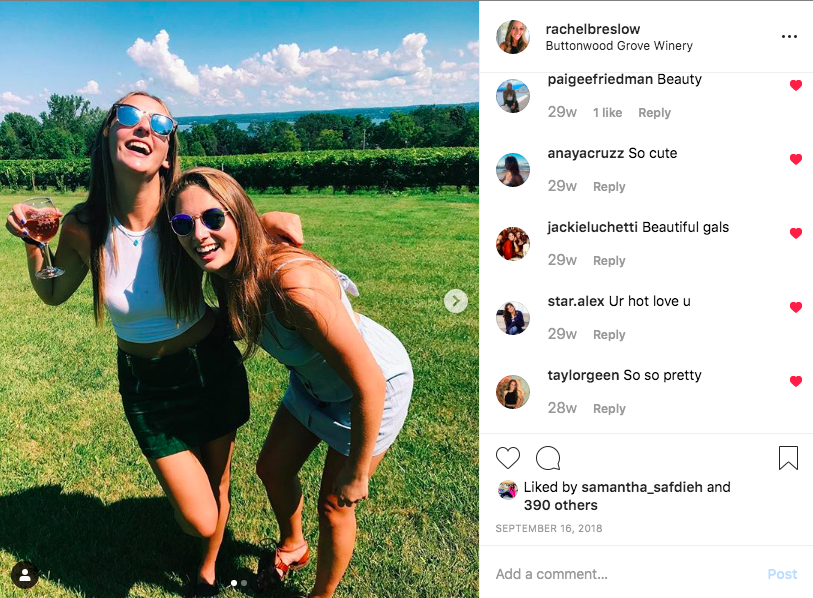
Prior to me coming abroad to Barcelona, my Instagram was very simple. I never posted anything too crazy and it was always with friends either at events or at school going out together. I rarely posted a picture of just me alone unless it was for a special occasion, and I would make sure to never post a picture of myself alone back to back from each other. My Instagram behavior was very simple to what we had discussed with the guest lecturer about unwritten social media rules. I never posted before a certain time of the day, I always made sure the picture I was posting went with the aesthetic of my profile, I never posted too often, and I never posted alone twice in a row. I usually posted an Instagram picture once every 2 or 3 weeks, unless there was a special occasion which I had pictures to share. Some of these “rules” are still in place today in my current Instagram usage, but some are different since studying abroad. For instance, in this picture below I posted on my Instagram on September 16th, I am with my friends at a winery laughing and having fun. It seems as though any normal Instagram post was for me prior to abroad; I am with friends at a special occasion or location. That still holds true now, however, the quantity of posts as well and the quality have increased tremendously.
Upon arriving in Barcelona, my mindset was immediately targeted for what my first Instagram picture would be. I know how wrong that sounds, however, that is the generation I was born into; we all care so much about our online appearances that we may sometimes lose track of what is right in front of us in reality. Looking back on my entire experience abroad, I definitely try harder to get the “perfect picture” in order to reflect the different trips and times that I’ve had here abroad. I find myself thinking more and more about the picture that I am going to get and post from certain locations than I have in the past. I put the same amount of effort into editing the pictures, however, now I have so many pictures of just myself than I ever have before. In the beginning, I would always overthink the fact that I was going to be posting alone and I cared so much about all of these unspoken rules. However, now I don’t really care about how many solo pictures I post and the pictures themselves are way more “aesthetically pleasing” than my posts prior to abroad.

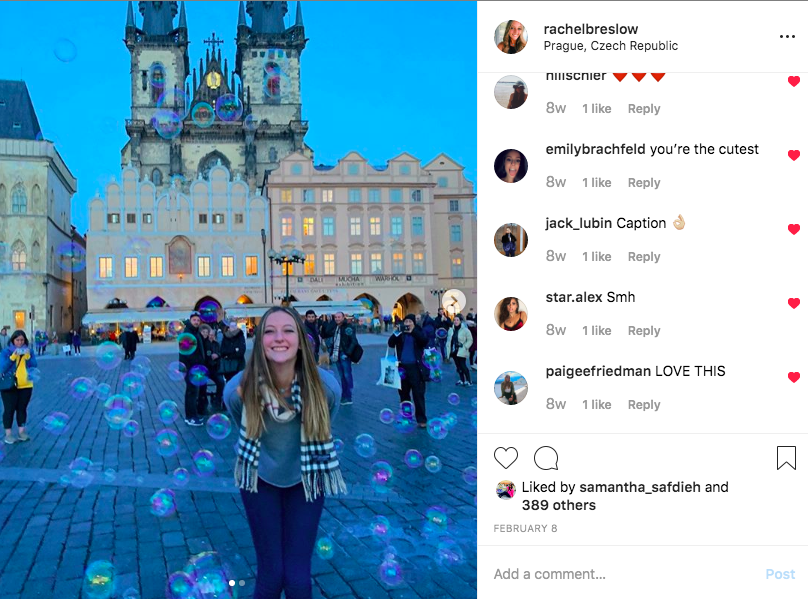
I find myself caring more and more about making my trips and locations that I am traveling to seem perfect, meanwhile before coming abroad, my Instagram more reflected the realities of the places I was whether I am drinking with friends or about to go out to a party. In this picture below, I was in Prague in one of the squares and my friends and I saw a man with bubbles that was letting people take their picture for 2 euros. My friends and I, obsessed with getting the perfect picture, all paid him 2 euros so we could all take pictures in from of the clock tower. Our obsession with getting the perfect shot and acknowledging to friends and family what a perfect time we are having is part of the mindset that all of my friends including myself have while studying abroad.
The posts I decide to share while living abroad reflect only the most “perfect” and best version of myself that I can be. I made a point to successfully Instagram from each place I have traveled to, and I have completed that goal. The pictures that I have posted though, reflect the most picture perfect and “classic” abroad pictures. However, I do feel as though that this behavior of mine was bound to occur, based on all of the incredible experiences I was blessed with having studied here.
Digital Celebrity and Social Media Strategies

With the increase of popularity of social media and the numerous social media platforms, many users that have gained a large following begin to create their own personal brand, whether they know it or not. This increase in popularity has created a new form of celebrity, one that focuses mainly on the connectedness wth fans, for they are the ones that carry out the influencers name and image. One of the social network sites that I follow very closely, which has many up-and-coming influencers, is Youtube. One of the more popular social media influencers that has over 11 million subscribers, is David Dobrik.

Over the past three to four years that David Dobrik has emerged onto the social media scene, he has made a huge splash in the social media market, in terms of personal branding. At first, he was just a high school student that would make 6 second videos on the application Vine. Once vine was no longer available, he switched applications and went onto Youtube. He now creates 4 minute and 20 second vlog videos that consist of him and his friends doing crazy things, as well as David rewarding his friends or gifting them very expensive gifts. My fascination with David began when I saw a video of him giving away three cars to his best friends. I began to ask myself how is it possible that he is financially stable enough to be buying his friends cars? So I started doing some research. David has partnered with the company SeatGeek, with when David gives them a shoutout in his videos, they allot him substantial money, which he then uses to buy his friends their dream gifts.

Screenshots from David’s Instagram story shouting out SeatGeek

The Youtube “celebrity” is something very new and different than our previous definitions of what a celebrity is. A celebrity used to be a person that you really would only see in the contexts of their professional fields, whether that be movies, television, music, sports, etc. However, with the introduction of Youtube and other social media websites, the idea of celebrity has many more meanings. They are way more connected and personable to their fanbase. For example, in David’s vlogs, it appears as though he is talking directly to the viewer, almost as if you are friends. You get the sense that you know exactly who David is because you are seeing him interact with his actual friends in his real life, not one that he is acting in. It is with this that David’s “brand” is established. David, along with other known vloggers on the same platform, “positions himself as part of his own fandom” in order to appear more relatable and likable to viewers and fans [1].

Social media influencer walk a fine line between celebrity and just your average person. They are “meant to be relatable, yet at the same time, be apart of the masses” meaning being something other than the rest [2]. Vloggers on Youtube “need to shift between authentic and staged intimacy on the same medium; they have to straddle the line between the familiar and the other” [1]. With this in mind, David does this by letting the fans into his world, however, with his editing style of his vlogs, still stands “apart from the masses.”

David’s digital identity on Youtube as well as other platforms can reflect many aspects of the honeycomb framework. For instance, his constant connectedness to his fans exemplifies the relationships aspect of this framework. Everything he does is for and because of his fans and he does everything he can in order to build a greater relationship with them. Another aspect of the honeycomb framework that David exemplifies is reputation. He knows where he stands socially in comparison to his friends and other youtubers and uses this in his own content and jokes with his friends.

Works Cited:

  1. Burgess, Jean and Joshua Green. 2008. ‘Agency and Controversy in the YouTube Community’
  2. Cunningham, Stuart & David Craig. 2017. ‘Being ‘Really Real’ on YouTube: Authenticity, Community and Brand Culture in Social Media Entertainment.’ Media International Australia 164, 1, pp. 71-81.

The Effect of Social Media on Relationships

The idea of digital identity is that ever since the introduction of social media and social networking websites, people portray themselves differently than they would in real life. People’s posts, pictures, videos and actions online and on their personal profiles display an image and reputation they wish to put out into the world. Beyond just posting pictures and word posts on these sites, social media has completely revolutionized the way that people interact on a daily basis, as well as the way romantic relationships are created and maintained, as well as broken off.

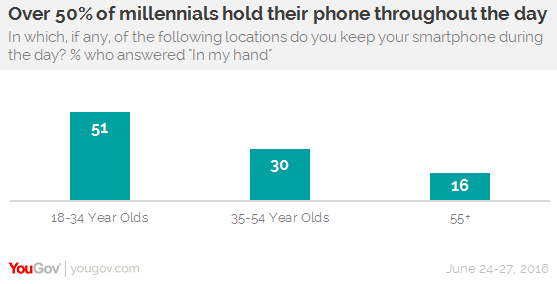
One major affect that social media has had on the daily lives of people is that many people, especially millennials and younger, have lost the complete ability to live in the moment. Anytime you see somebody of this age cohort, they will 9 times out of 10 have their cell phone in their hand whether or not they are using it at all. Our phones have become an extension of our hands. According to a survey conducted by YouGov Omnibus, “just over 50% of millennials report that they now carry their phone in their hand throughout the day” [1]. The following graph is the survey from this study showing the age groups that carry their phones in their hand throughout the day.

The fact that millennials are constantly in contact with their cell phones, deviates the reality of almost every situation they are in. They would much rather take a picture and text their friends about the places they are going and have been, rather than actually enjoying it in the moment. I myself am guilty of this in many aspects. My phone is always in my hand whether I am using it or not, and I am always on social media whether just taking pictures on snapchat, or scrolling through Instagram to see other people’s pictures. As sad as it seems, this is the way that almost all people my age interact and live life.

Not only does social media and cell phones impact daily interactions with people, it also affects intimate relationships with family and friends and significant others. It seems, in this day and age, that many couples take pictures and post with each other only to receive reactions and feedback from everybody that isn’t them. They want the most likes and they want to show off that their happiness together is better than other peoples’. I have seen this happen first hand with my own friends. They will take pictures and post with their boyfriends or girlfriends just to get the most likes or views on a picture, rather than just focusing on being with their significant other. I have also witnessed couples spend 15+ minutes taking the same picture because the girl didn’t like any of them and wouldn’t stop until she was satisfied. This constant obsession with what other people are thinking of our own personal lives is completely heightened with the institution of social media and SNS.

Beyond what other people think of them, social media can also have a huge impact of what partners can think of each other based on their social media activity. I have witnessed numerous relationships break up over something on social media, whether it was somebody liking a certain persons pictures, or subtweeting about their significant other, or commenting things on somebody else’s picture, social media is, a lot of the times, at the center of most conflicts nowadays. According to Kenadie Wilkerson in Inquiries, she talks about how “social networking sites allow us to see things on our partners profile that can influence our emotions towards them” [2] such as anger and jealousy, which can lead to nasty fights and even breakups. Everybody reads so much into everybody’s activity on their social media accounts that it is like we live another life on our profiles that is completely different from our own.

One’s digital identity is so crucial and important to who they believe that they are, whether it is an accurate representation of them in real life or not. A perfect example of this is the rising popularity of Tinder and other dating websites. The idea is to make yourself appealing to whoever you are trying to impress, so you create the most fake and most “perfect” version of yourself just so that other people will think you are more interesting or beautiful than you are in real life. This is the case with most people whether they know it or not. Everyone is always trying to post the best looking photos with the best edits, and no one really posts pictures where they look “real.” This is a rising issue nowadays with millennials and younger generations that I do not see a solution in sight.

Works Cited:

  1. Heibert, Paul. “Half of Young People Hold onto Their Phone throughout the Day.” YouGov, July 6, 2016. https://today.yougov.com/topics/lifestyle/articles-reports/2016/07/06/young-people-carry-phone-in-hand.
  2. Wilkerson, Kenadie. “Social Networking Sites and Romantic Relationships: Effects on Development, Maintenance, and Dissolution of Relationships.” Inquiries 9, no. 3 (2017). http://www.inquiriesjournal.com/articles/1576/social-networking-sites-and-romantic-relationships-effects-on-development-maintenance-and-dissolution-of-relationships.

Nosedive: Social Ranking Systems

In this chapter of Black Mirror, a future of social ranking and intense self awareness in portrayed. The story is centered around Lacey, a typical female who is obsessed with the ranking system that has taken over society as she knows it. In this future, every single interaction anybody has with anyone is rating out of 5 stars, and that rating averages in with the overall rating of the person as a whole. In this world, everybody is wearing contacts that when you look at anybody around you, it states their rating. It is so regular in this society to behave as best as you can in order to get the best rating from people. If you piss people off or are rude to them, you will get a bad rating and therefore lower your overall rating. This world, according to Sophie Gilbert from The Atlantic, is a “pastel-colored nightmare of aggressive cheeriness, as citizens attempt to out-nice each other and bump up their ratings” [1]. The people with the higher ratings also have the biggest influence on other people; for instance, if somebody with a 4.8 rating gives you 5 stars, your average rating would go up higher than if somebody with a 4.0 rating gave you the same 5 stars.

In this society as well, having a higher rating means that you get the perks that the world has to offer. For example, Lacey is trying to rent a new apartment to move away from her brother, who has a low 3.2 rating. In order to receive a 20% discount on the apartment, which is the only way she’d be able to afford it, she must be a 4.5 rating or higher, and she was currently only at a 4.2. Therefore, Lacey began making herself crazy in order to receive higher ratings from everybody in order to receive benefits for herself. The entire society is completely encapsulated with themselves and the self-awareness of every interaction, and all relationships and interactions are never real and meaningful, they all are only to boost one’s own rating.

As crazy and insane as this society seems, our society is not that far off from this type of mentality. Yes this is very exaggerated and we aren’t “rating” each other to each other’s faces after every interaction, we are always obsessed with how others view us and how it affects our reputation. Instead of ratings, this can be viewed in the amount of followers or likes one has. If somebody has more followers or likes than somebody else, they can be viewed as better or more popular and better off. So many people have the mentality of getting and having the best post in order to receive the most praise and feedback from followers, that real interaction and enjoyment on what’s happening in the moment is slim to none.

A social ranking system is essentially what is happening in this chapter. Everybody is ranked based on their lifestyles, choices and interaction and it therefore has an impact and effect on their daily lives. Based on what their rank is, other people can immediately make inferences about the type of person they are and what they are capable of doing. According to Business Insider, China, by the year 2020, will be implementing a “social credit system” where they will “rank all its citizens based on their ‘social credit'” [2]. With this, people will either be rewarded or punished according to their scores, which is very similar to the world we saw in Nosedive. Also, a person’s “social scores can move up and down according to their behavior” [2].

I personally believe that with the implementation of this social ranking system, it will make almost all interpersonal relations fake and indecent. Nobody will ever speak the way they truly feel about any situation in fear of getting a lower social rank, therefore, losing out on certain benefits and privileges. The entire concept of free speech will be obsolete because no one will ever want to speak out of turn. This is a step toward making humankind into robots; having no personal stance on anything and being afraid to be individuals and different.

Works Cited

  1. Gilbert, Sophie. “Black Mirror’s ‘Nosedive’ Skewers Social Media.” The Atlantic. October 21, 2016. https://www.theatlantic.com/entertainment/archive/2016/10/black-mirror-nosedive-review-season-three-netflix/504668/.
  2. Ma, Alexandra. “China Has Started Ranking Citizens with a Creepy ‘social Credit’ System — Here’s What You Can Do Wrong, and the Embarrassing, Demeaning Ways They Can Punish You.” Business Insider. October 29, 2018. https://www.businessinsider.es/china-social-credit-system-punishments-and-rewards-explained-2018-4?r=US&IR=T.

My First Wikipedia Post

When I was told I had to come up with a topic to create a Wikipedia page about, I was immediately stumped because my first though was “what isn’t there a Wikipedia page about?” It seems as though there is a Wikipedia answer for everything nowadays, which imposed my first problem of this assignment: what should I write about? Then I started thinking about my own knowledge and passions and what I would know a lot about that maybe others would not. And then it hit me: volleyball. Yes there is a page about the game of volleyball on Wikipedia already, but I wanted to create a page for the people interested in the intricacies of the game and for the referees of the game who want to know the in depth rules that college and professionals play. Not just the basic rules that you would learn at a day camp.

I have been playing volleyball competitively since I was about 11 years old. I was almost going to play competitively in college but decided against it, so now I play for the club team at my school instead. Volleyball is one of the most important things in my life, and because of this, it is something I have great knowledge for that I feel others would be interested in learning more about.

One thing for sure that I did not know about Wikipedia was how hard it was to actually get your material out there to the public. Wikipedia has this bad reputation because it is know that “anyone can edit a post.” And yes, while that may be true, there are so many restrictions and rules to actually get an edit approved and then published. There are so many editors that work for Wikipedia that constantly oversee users’ edits and they have the final say as to whether or not a post or edit can go public.

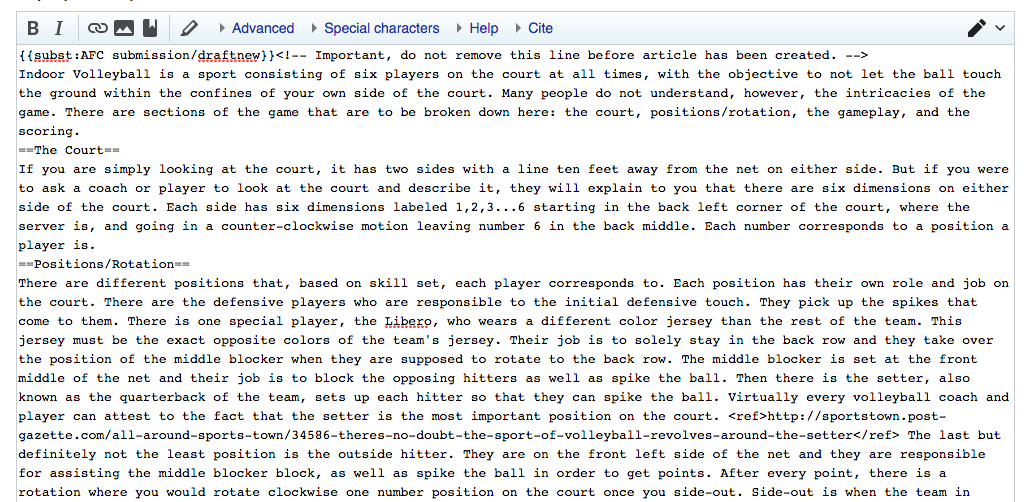
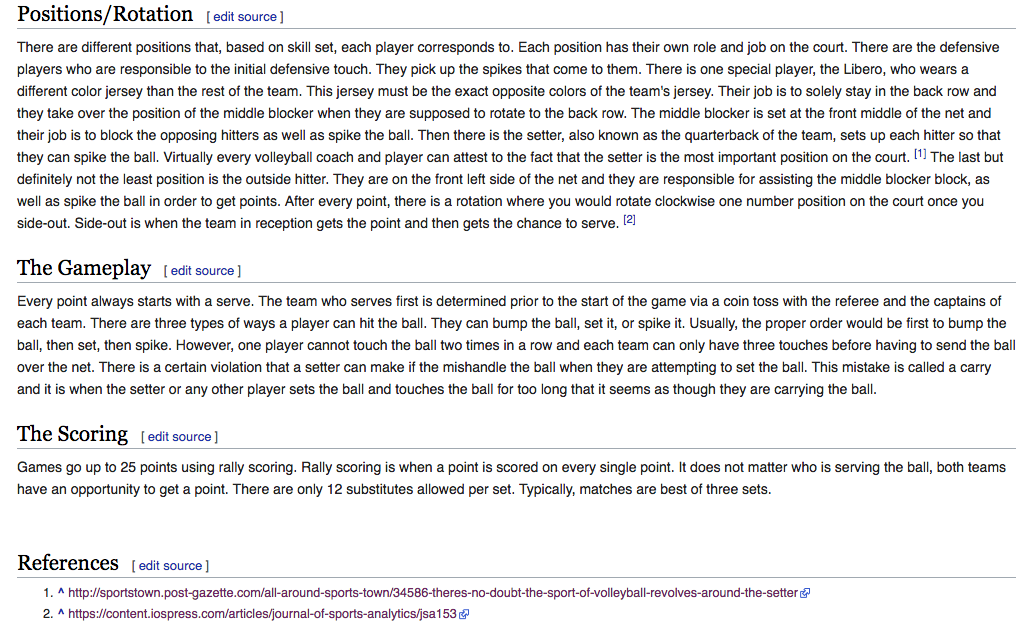
Immediately when i started working on my page, it looked as if I was doing some sort of advanced computer coding. I was completely out of my comfort zone, which is saying a lot because I believe I am pretty technologically savvy. There are so many short cuts and tricks as to how to format your page, for instance, getting a table of contents, or even simply bolding or underlining words and phrases. Thankfully Wikipedia provides a helpful cheat sheet that provides some of the useful codes needed. The draft box looks as follows with my content written in the box as well.

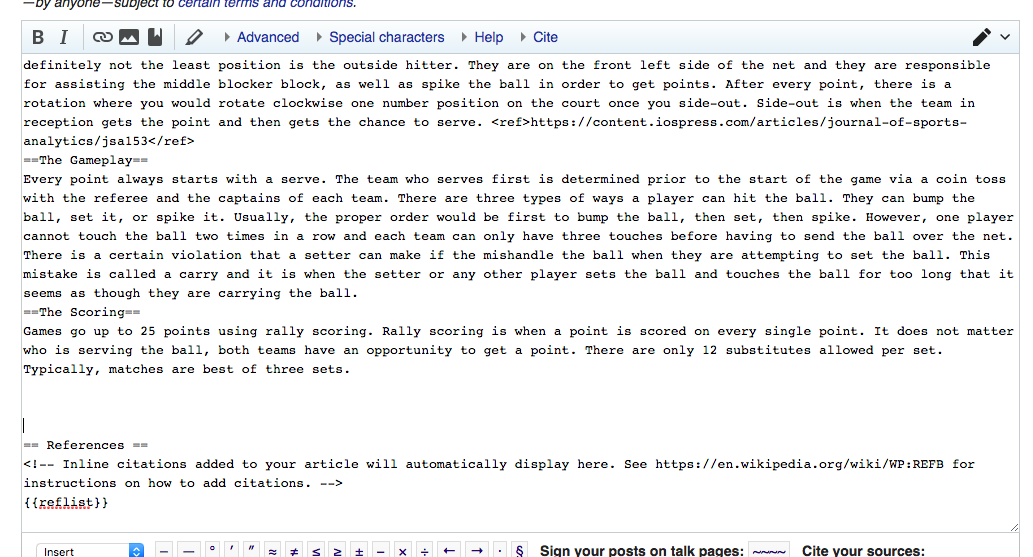
The draft box has you put in your references as well as separating your ideas and making a table of contents all by code, which was something very different than what I was used to.

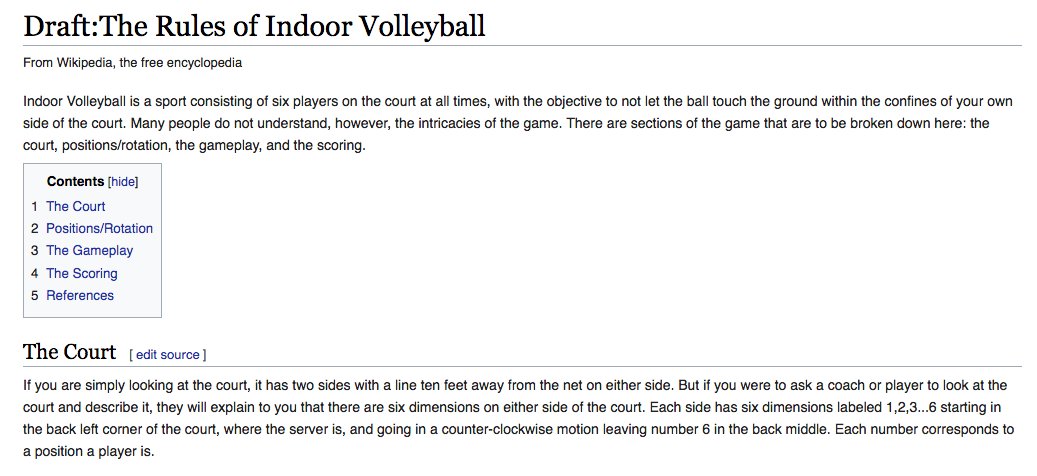
Looking back on the overall experience with creating this post, I completely underestimated the accuracy and time and effort that goes into Wikipedia. Creating a post on this website is definitely harder than it seems to be. However, the payoff is well worth it. My page is still under submission, however, here is what the draft of my first Wikipedia post looks like. Here is “The Rules of Indoor Volleyball.”

Memes Used for Digital Activism

Nowadays, it seems nearly impossible to go about your day and not see some sort of meme surrounding either a political or activist issue. The idea surrounding “memes” and meme culture is that it is any picture or trend that is replicative can be manipulated and changed easily in order to bring out a certain idea or response. Since its beginnings, memes have been shared and changed and shared again for everybody to see. Many may think that the only purpose of memes is to make people laugh and then be done with it. However, they hold so many more important purposes. They can bring out the smartest ideas in people, promoting great change and thought.

According to writer Stephanie Vie, “memes operate within cultures and are responses to the desires, interests, and needs of the specific host culture within which they emerge and spread” [1]. This holds true with most memes we see today on any social media platform. No matter the issue or circumstance in the “host culture,” there is sure to be a meme surrounding that idea. In order to have a successful meme, however, they must be “attuned to the social and cultural specifics of their audience” as well as “play on familiar visual or textual concepts or rely on culturally relevant songs, jokes, or sayings” [1]. Meaning the memes have to play to their audience. If you are trying to get the attention of young adults, the meme would contain different language and references than would a meme trying to attract the attention of adults. We see this with the exponential rise of political memes.

A political meme can be described, as Chris Tenove states, as “a purposefully designed visual framing of a position,” meaning a visual representation of how somebody stands on a particular issue surrounding politics [2]. Either for the purposes of making people laugh, simply raising questions or ideas about a certain topic, or even enlightening people about something they may not had known prior. I know I definitely have learned so much political information from memes that I otherwise would not have known because I am not very involved in politics.

Since Trump’s Presidency, there has been a dramatic rise in meme culture and its prevalence in daily life. Everyday it seems as if a Donald Trump meme is scratching the surface. The reason for its success is because it is so sharable and relatable for so many people, depending on their political interests. There are both positive and negative memes regarding Donald Trump, but nonetheless, he has completely revolutionized meme culture as it stands.

Beyond just political use, memes are also used to bring about social change. The examples are endless with the black live matter movement, the gay pride movement, the #MeToo movement and so much more. These memes bring attention to the situation at hand surrounding a major social issue. Without the traction that memes have, many of these issues and trends would not have become as big as they could have been. Social media websites are so prevalent in the spreading of ideas that without them, many of these movements would be disintegrated.

I believe that the use of memes as a path for activism is a smart and good use of the platform. Yes memes are funny and can make you laugh, but memes that also bring your attention to important matters at hand are ones that you will remember for longer. The fact that a picture or video can stay with you and can be modified is so special and integral for our society today. In a day-in-age where cell phones and the internet is so prevalent, it is good that people are making use and spreading important messages and beliefs through this forum.

Works Cited:

[1] VIE (2014) “In defense of slaktivism: The Human Rights Campaign Facebook logo as digital activism”

[2] TENOVE (2019) “The meme-ification of politics: Politicians & their ‘lit’ memes”

Evil Kermit: Meme Origin, Meaning, and Modifications

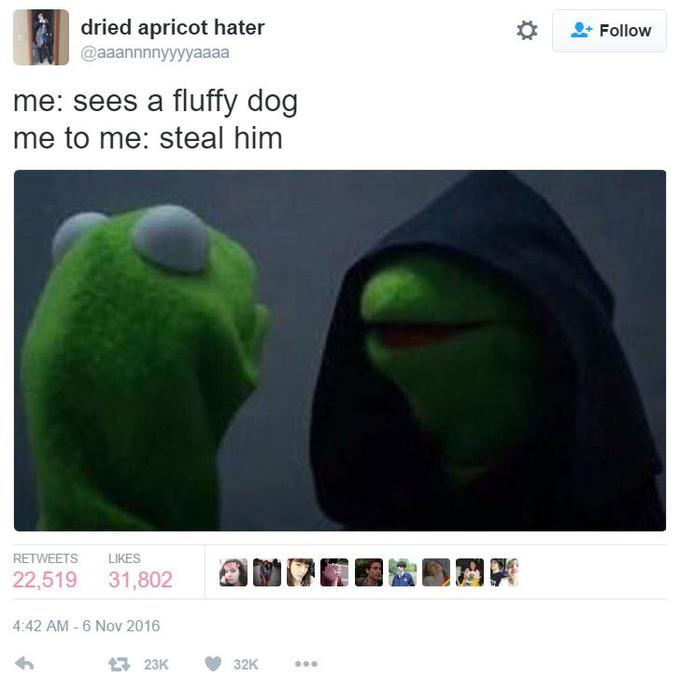
The meme I will be analyzing is entitled “Evil Kermit,” where Kermit the Frog is seen facing his nemesis who in part tells him to make the clearly wrong or bad decision in whatever situation Kermit put himself in. Evil Kermit is shown in a black cloak covering his eyes facing Kermit as shown below.

This photo comes from the Muppet comedy film Muppets Most Wanted in 2014, where Kermit is confronted with his “look-a-like Constantine dressed in a black cloak” (Know Your Meme). Two years after the movie’s release in 2016, the twitter account @aaannnnyyyyaaaa posted the meme that started it all:

The idea surrounding this tweet is similar to the devil and angel metaphor where there is a good decision and a bad decision. In the context of this tweet, the “devil” would be the Kermit in the black hood, always trying to convince Kermit to make the decision that goes against what Kermit originally wants or believes in.

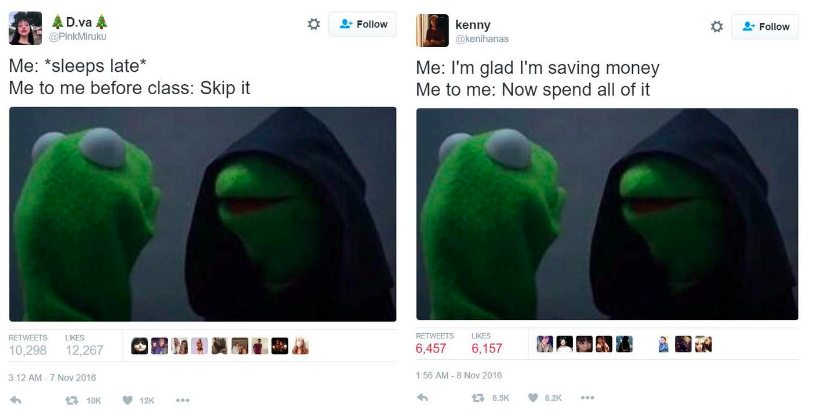
After this meme was posted in 2016, it gained instant popularity. Naturally, other versions of this meme began to reach the surface. In fact, the next day after this meme was originally posted, “Twitter user @PinkMiruku posted an Evil Kermit who instructs her to skip class, receiving upwards of 12,200 likes and 10,200 retweets over the next eight days (shown below, left). On November 8th, 2016, Twitter user @kenihanas tweeted the picture along with a caption about feeling tempted to spend his saved money (shown below, right)” (Know Your Meme).

This meme has spread so popular and onto multiple social media applications. I have seen examples of this meme of Twitter, Instagram and also Facebook. Because this meme is not that complicated to understand, it reaches a wide audience and can be used for different age cohorts and in different scenarios. It also brings a sense of nostalgia for some because Kermit the Frog is a very popular character from the Muppet Show, a show that many people know from when they were children. To see Kermit struggle with different dilemmas created by social media users creates a sense of unity in that it is collectively funny and sharable.

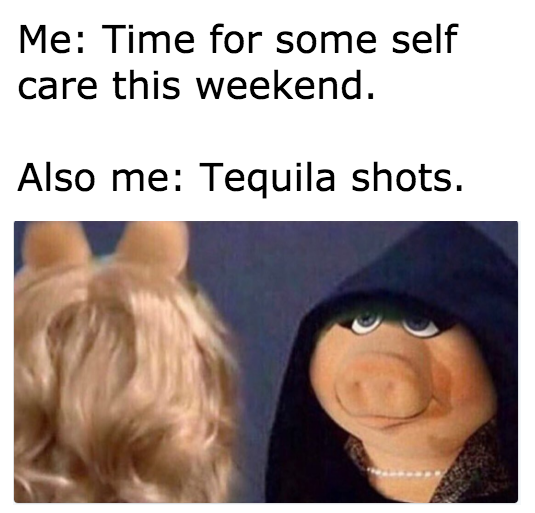
This post has also morphed to different characters from The Muppets. There is also a strain of memes called “Evil Miss Piggy” where it is the same setup as evil Kermit however, it is Miss Piggy under the black hood facing herself. An example of this is shown below:

This modification of the Evil Kermit tweet was also wildly popular and especially for references regarding specific female situation, for Miss Piggy is a female herself.

I believe the main purpose of this meme is simply comedic. Each meme of Evil Kermit displays a scenario that is light-hearted or comical that most people either think of or face on a daily basis, so it is very relatable. In my own efforts, I tweeted my own meme of Evil Kermit shown below:

Works Cited:

Know Your Meme: https://knowyourmeme.com/memes/evil-kermit

Social Network Sites Timeline & Media Evolution

My name is Rachel Breslow and I am a 20 year old female and a junior in college. My first SNS account was Facebook in the year 2009. I was 11 years old and it was around the time that all of my friends started getting Facebook accounts as well. At first my parents did not want me to get one, but after my best friend’s parents let her get one, I practically begged them to let me have one and they finally agreed.

My first account was Facebook, and I was so overwhelmed with excitement and every chance I got I was on the computer chatting with friends and making posts and being completely encapsulated by it. Then I got a tumblr, which was a really cool concept because I was a collection of cool pictures and posts that seemingly went on your own “website” of sorts. Then came twitter, then youtube, then Instagram, then snapchat, then vine. All of which are still prominent in my life, except vine because it is no longer available.

Nowadays, I believe I currently use 5 main SNS. I primarily use Snapchat and Instagram, but I also use twitter and Facebook and Youtube.

My two preferred SNS are Snapchat and Instagram so it is hard to choose. If I think about, I feel like I end up using snapchat more than I do Instagram. Snapchat is an application that lets you send pictures or videos with messages directly to specific people or a lot of people at once. It can be used for communicating with friends and establishing relationships. Snapchat is one of the most popular applications among my age cohort for its accessibility and the fact that it is a fun application.

Snapchat enhances intimacy and personal connections between its users in both visual communication and textual communication. Beyond just sending individual pictures and videos to select people, which has very high intimacy and privacy levels, one can also post pictures or videos to their “story” which is a compilation of highlights from the last 24 hours of that person’s day that they wish to share with whoever is on their contacts.

The quality of pictures is obsolete in snapchat. A lot of the time when you are sending an individual snapchat to a friend, it most of the time will be a funny selfie or a picture that you did not spend much time taking. Unlike applications like Instagram, where there is a lot of editing that goes into the pictures put out, snapchat requires much less time, making good quality pictures obsolete.

The act of chatting constantly with an individual person can trace back to applications such as Facebook messenger or even AOL messenger. These applications heightened solely direct and instant communication between two users and snapchat similarly follows this pursuit.

In my opinion, what is reversed in snapchat is the idea of temporary pictures and videos. As discussed in class, the logo of snapchat is a ghost, meaning that these pictures and videos are meant to disappear after a period of time. If you are sending pictures to an individual person, the picture will only last for 10 seconds maximum. If you are posting on your story, the picture or video will last on your account for only 24 hours then disappear. No other SNS has this ability to make the picture and videos that you send or post disappear, which is a big reason many people are a fan of this application. The excitement of having their pictures and videos only last for a short time is intriguing for many, including myself.

Ambient Awareness: Social Media & Sense of Virtual Belonging

Ambient Awareness is a term coined by social scientists used to describe a new form of peripheral social awareness. With the emergence of Facebook, Twitter, and other social media platforms, the need and urge to feel connected and aware of others ongoings and lives is at an all time high. The awareness aspect of this term comes from the user’s omnipresent knowledge that these media outlets and applications allow one to stay constantly connected with one’s social circle, including people they would otherwise not talk to or know anything about. According to Clive Thompson of the New York Times, ambient awareness is very similar to “being physically near someone and picking up on [someone’s] mood through the little things [they] do” (1) such as body language, sighs, etc. Having your entire life shared on a social platform is much like being right next to somebody at a restaurant sharing what you did this past weekend. Instead, anyone can see via a post you would share.

This idea came about from the release of the News Feed on Facebook, where, whether you would want to or not, whatever you post, or friends post about you, it is easily shown to everybody on your friends list. At first this received a lot of backlash for there seemed to be no sense of privacy whatsoever, but soon after, our urge to feel connected and informed changed our perspective on the matter. Thompson explains how many people, particularly people over the age of 30, they did not understand this urge and need to update the world on their everyday lives. He begins to talk about Ben Haley, a 39-year-old man whose friends urged him to get a twitter account when at first he thought the whole concept of it was “silly.” At first, he would check twitter and believe that “each tweet was so brief as to be virtually meaningless.” But as days went by, he started to realize how in sync he was becoming with his friends and he found himself checking twitter multiple times an hour.

This idea of feeling connected is so important in the everyday lives of social media users, including myself. For me, my two biggest social media platforms are Instagram and Snapchat. What I see that has been happening with myself and all of my friends is that we go to insane lengths to get the perfect Instagram picture instead of actually taking in the scenery of what is actually going on around us. I am personally guilty of this every time I go sightseeing or to a new place or out with friends. We all are so obsessed with getting the perfect picture that a lot of the time we miss what is going on around us. The problem of constantly using our phones for snapchat and Instagram has gotten so out of hand that my friends and I make rules for when we go out to dinner, for example, where none of use are allowed to touch our phones for the entire meal, and if you do, you pay for the entire meal.

According to Jacob Silverman of The Guardian, there is a common saying nowadays with the “Instagram Era” titled “Pics or it didn’t happen” (2). This saying is used very commonly among Instagram and other social media platform users and the idea surrounding this saying is that if you go somewhere or you do something and you did not capture a picture, it is as if the moment never happened because you will not be able to share the post on any of your social media platforms. This saying completely shows what is wrong about the “social media problem” demonstrated through our desire to stay connected with one another. We lose our happiness to live in the moment and instead we are living through our cameras on our phones. The following Instagram post expresses this saying exactly. Here, a woman is at the Louvre in Paris with the hashtag in her caption “#picsoritdidnthappen” as she is clearly not looking at what is behind her. One can only assume how long she spent getting the “perfect shot” instead of spending that time walking and taking in the art of the museum.

I have wondered for so long what it is about social media that makes us go crazy, and a part of the answer is the ambient awareness of us wanting to feel connected in a sort of way. The comfort of knowing what is happening in the lives of our friends and family as well as boasting about our own life is a driving force for a lot of people. Having both good and bad sides, the idea of social media has definitely changed the way we engage with other people and with ourselves.

Works Cited:

  1. Thompson, Clive. “Brave New World of Digital Intimacy.” The New York Times, September 5, 2008. https://www.nytimes.com/2008/09/07/magazine/07awareness-t.html?_r=2.
  2. Silverman, Jacob. “‘Pics or It Didn’t Happen’ – the Mantra of the Instagram Era.” The Guardian. February 26, 2015. https://www.theguardian.com/news/2015/feb/26/pics-or-it-didnt-happen-mantra-instagram-era-facebook-twitter.
Featured

About Me!

My name is Rachel and I am a junior at Binghamton University! I’m from Long Island, New York which is my absolute favorite place in the world. I am an Applied Psychology major and I hope one day to be a Special Education teacher for children with autism. For my spring semester, I decided to study abroad in Barcelona and I can already say it is one of the best decisions I have ever made. This city is so beyond beautiful and the culture here is so rich and infectious. I love immersing myself in something new and to try my hand at a new language is something so exciting to me. My favorite social media apps are Instagram (@rachelbreslow) and Snapchat (@rachhbress) and Youtube. I use social media multiple times a day every day. When I am bored and even involuntarily, I am going onto social media. I love watching vloggers on Youtube, one on which being David Dobrik. Using the 6 degrees of personality theory, I am 4 degrees of separation from him because my friend met Drake Bell, and Drake Bell, knows Josh Peck and Josh Peck knows David. My email address is rbreslo1@binghamton.edu